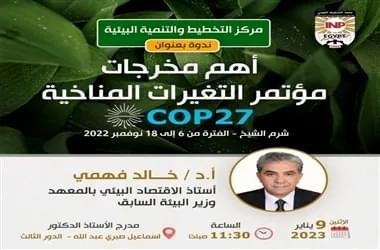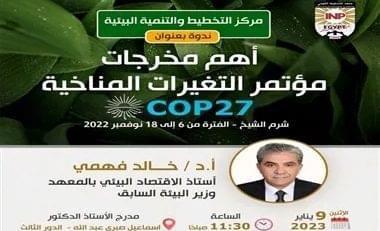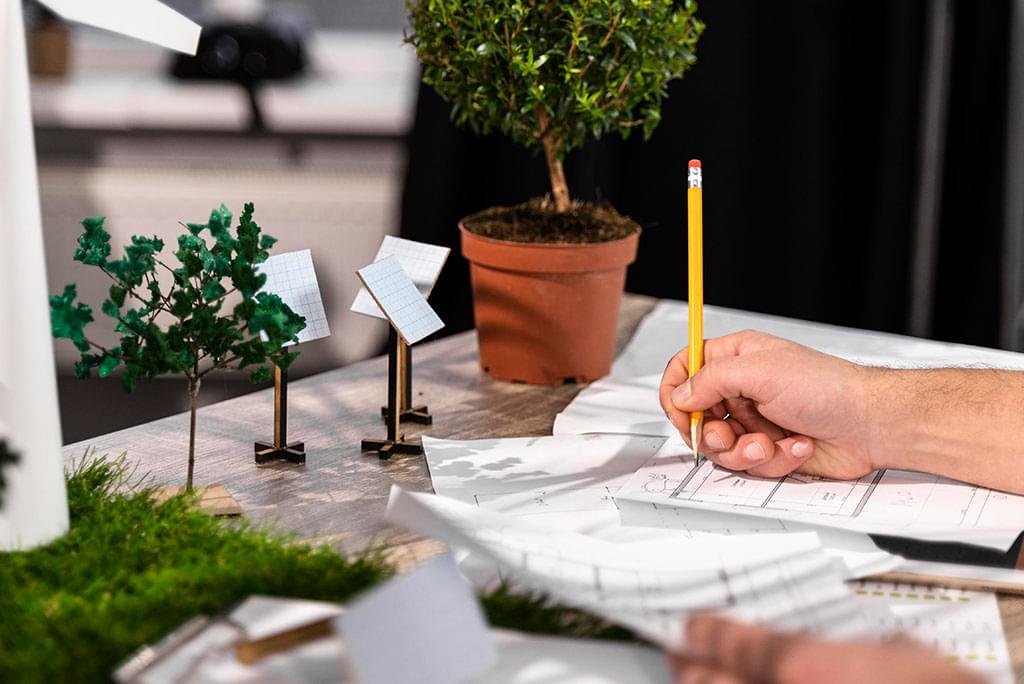


Overview of the Center’s Activities
The Center for Environmental Planning and Development (CEPD) is one of the core scientific centers at the Institute of National Planning (INP). It focuses on environmental planning at all levels, addressing challenges in natural resource management, sustainable development requirements, and integrating analytical tools from economics and environmental sciences. Its activities include measuring environmental costs and benefits, conducting environmental impact assessments for projects, and evaluating the ecological effects of economic and social policies—aligned with global best practices to enhance environmental planning and monitoring across governmental and non-governmental entities in Egypt.
The center actively engaged with the INP’s previous Strategic Plan (2015/16–2019/20) by formulating its own vision, mission, and strategic objectives. It implemented qualitative initiatives to support the institute’s goals, employing performance indicators to evaluate progress and leveraging lessons from past strategic planning experiences.
Moreover, the CEPD collaborated with the Strategic Planning and Quality Assurance Committee and INP’s senior leadership in drafting the new INP Strategic Plan (2020/21–2024/25), which introduces updated objectives to meet emerging institutional priorities. The center’s academic and support staff completed self-assessment forms for the new plan and contributed proposals for the institute’s key activities, including workforce needs for the upcoming phase.
Guided by these efforts and the INP’s renewed strategy, the CEPD developed its Strategic Plan (2020/21–2024/25), anchored in the following principles:
- Aligningwith the INP’s vision, mission, and values.
- Defining strategic objectivesthat advance the institute’s goals.
- Implementing actionable programsto support INP’s operational plans.
- Fostering collaborationwith other INP centers to achieve shared objectives.
- Strengthening partnershipswith domestic and international stakeholders.
- Highlighting the center’s unique expertisewithin the INP’s framework.
- Ensuring active participationof academic and supporting staff in goal setting and execution.
The CEPD is committed to reinforcing the INP’s pivotal role in advancing sustainable development in Egypt through research, innovation, and policy-relevant contributions.
CEPD’s Activities
The center’s work is structured by the following divisions:
- Environmental Planning Division
- Integrated waste management planning (solid and hazardous).
- Climate change adaptation strategies.
- Urban resilience against natural hazards.
- Mitigating environmental impacts.
- Sustainable development implementation.
- Natural Resource Management Division
- Renewable resource management (air, water, land).
- Non-renewable resource management (petroleum, coal, gas).
- Conservation of historical natural resources.
- Biodiversity preservation strategies.
- Population pressures and environmental impacts.
- Policy proposals for optimal resource use.
- Future scenarios for natural resource utilization.
- Environmental Economics Division
- Economic-environmental modeling.
- Multi-level sustainable development.
- Technological change and ecological effects.
- Globalization and environmental degradation.
- Biodiversity economics and conservation.
- International trade and the environment.
- Waste recycling economics.
- Post-2025 sustainable development.
- Compliance with environmental laws and regulations.
- Green economy.
- Environmental Accounting Division
- Natural resource accounting.
- Integrating environmental costs/benefits into macro, sectoral, and unit budgets.
- Adjusting national accounting systems for environmental factors.
- Enhancing pollution and resource depletion measurement/disclosure.
- Environmental auditing and control methods.
- Sustainable balanced scorecard frameworks.
- Environmental feasibility studies for projects.
- Corporate environmental and social responsibility.
CEPD’s Strategic Objectives
Derived from the INP’s goals, the CEPD’s objectives focus on supporting research, training, education, consultancy, social responsibility, and environmental stewardship. Key aims include:
- Expanding applied research and environmental consultancy.
- Addressing emerging scientific challenges to serve local communities.
- Participating in local, regional, and international conferences/workshops.
- Delivering training programsto build environmental sector capacity.
- Developing specialized academic programsfor applied research aligned with Egypt’s needs.
- Strengthening collaboration with environmental science institutions globally.
- Contributing to the INP’s social responsibility initiatives.
- Providing competitive advisory servicesin the center’s focus areas.
- Proposing policy alternativesfor decision-makers.
- Enhancing the center’s self-financing capabilities.
- Supporting INP centers in quantitative methods and IT applications.
- Building specialized human capitalin environmental planning and development.
Register your data and we will contact
you as soon as possible
Prof. Khaled Abdul Aziz
Vice President of INP for Research and Postgraduate studies
Prof. Sahar Ibrahim Al-Bahaai
Director of Planning & Environmental Development Center

Prof. Nafisa Saied Abo ElSaud
Professor Emiratus

Dr. Mona Sami Talaat
Associate Professor and Head of Environmental Accounting Department

Dr. Walaa Hussain Abdulallah
Assistant Professor

Dr. Shimaa Saied Mohamed Azab
Assistant Professor

Eman Mohamed Esam
Assistant Lecturer

Prof. Khaled Mohamed Fahmi
Professor Emiratus

Aya Nagah Abdul Maleh El-Sersi
Assistant Lecturer

Asmaa Hamdi Moustafa Ali
Assistant Lecturer